Noisy pose
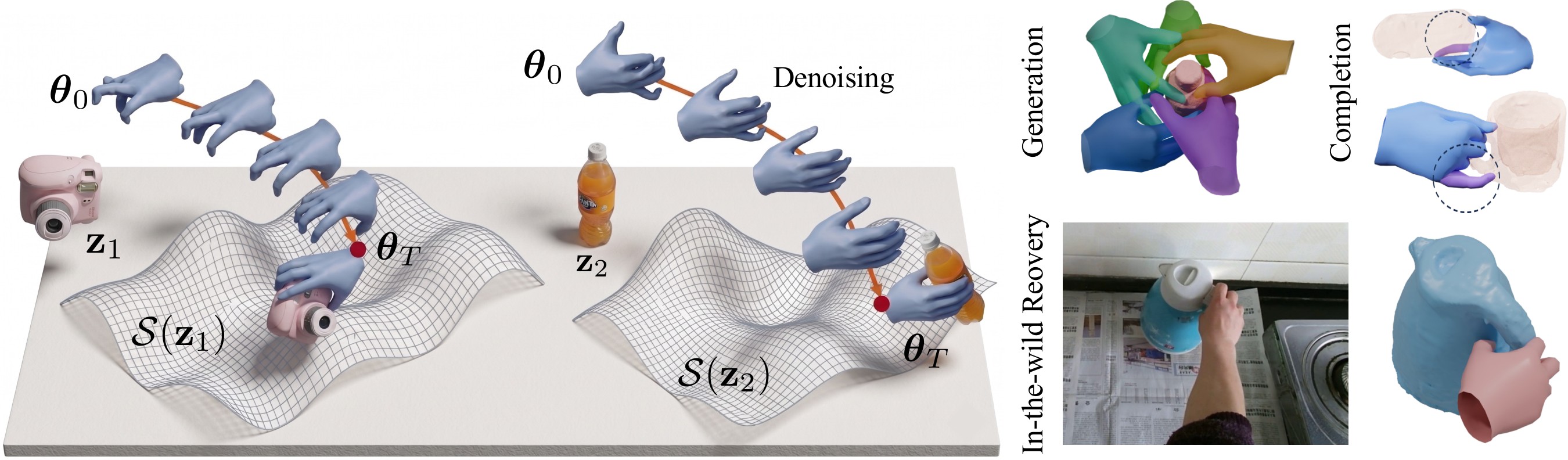
We propose, HaNDF, object-conditional neural distance fields as data-driven priors for modeling the plausible hand–object configurations, in the product manifold of hand articulations. While recent unconditional generative priors showed success in modeling human pose, hands are versatile articulated bodies often found in interaction with other objects. This makes it crucial to develop a generative prior which can model the plausible hand poses conditioned on the object under interaction. To this end, our HaNDF proposes a geometry-aware, object-conditioned neural distance field, representing the plausible articulations in the zero-level set of a conditional field. We leverage tools from Riemannian geometry to (i) represent plausible hands in the zero level-set of an object-induced neural field, and (ii) project a given pose onto the this field. Using HaNDF, we can also optimize for a plausible condition, determining the object under interaction. Our extensive evaluations demonstrate that our HaNDF provides a flexible and powerful prior for hand–object interaction, suitable for applications such as pose refinement, reconstruction under occlusion, and physically plausible manipulation synthesis.
Each hand pose is a point on a product manifold of unit quaternions, MH = ℍ1K, with one quaternion per joint. The distance field is learned with respect to the geodesic distance on this manifold.

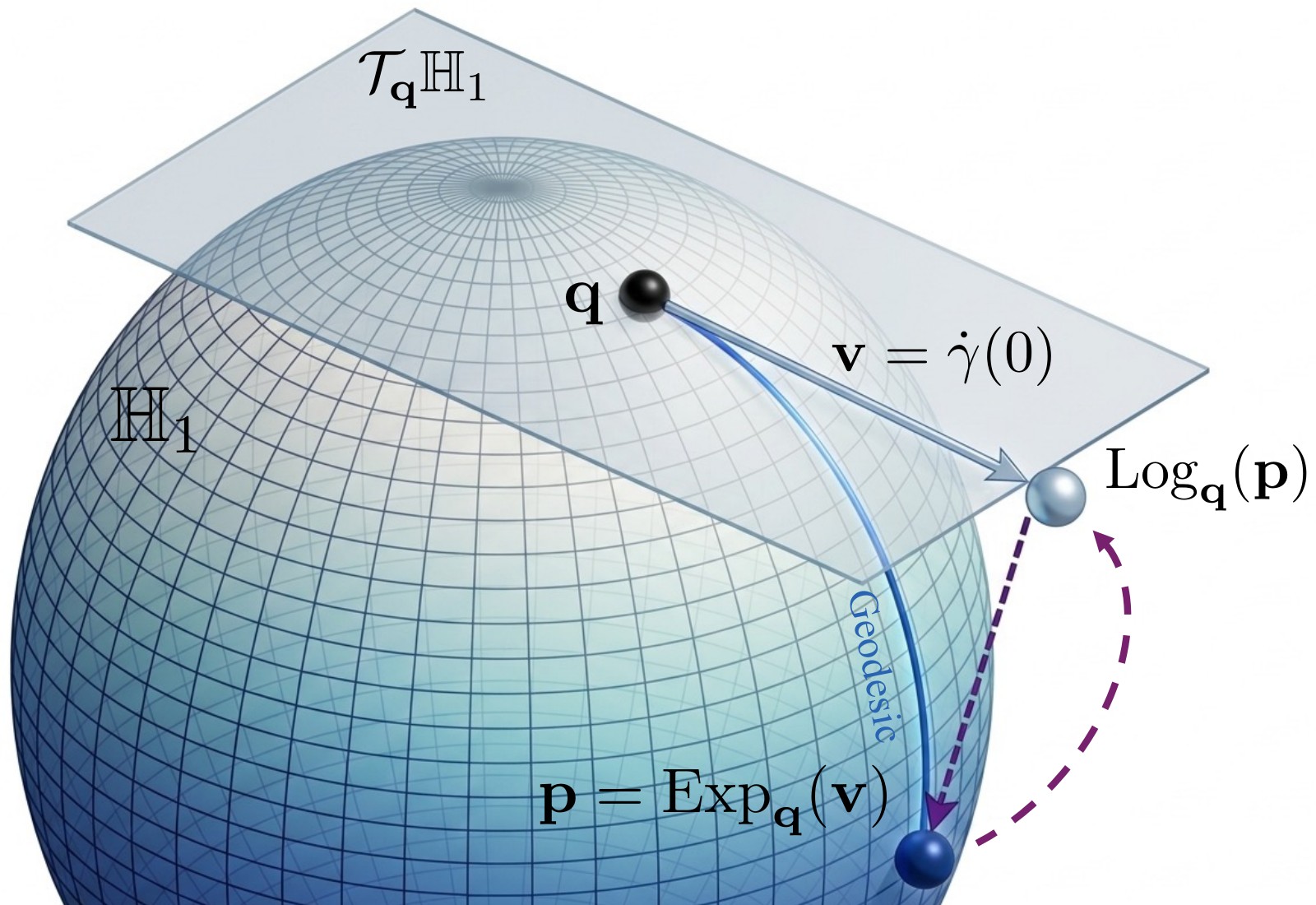
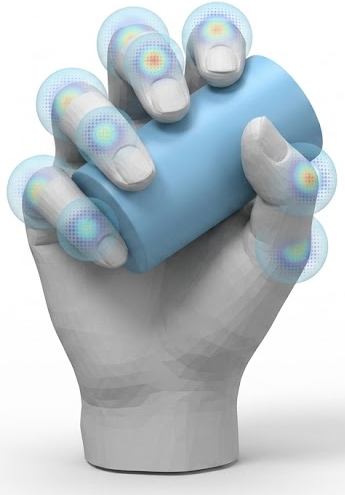
Left: the unit-quaternion sphere ℍ1, the tangent space at q, the geodesic from q to p, and the maps Expq and Logq. Right: per-joint rotation distributions of one grasp.
fΦ(θ | z) is a network that maps a pose θ and an object latent z to the geodesic distance from θ to the nearest plausible pose for that object. The plausible poses form the zero level-set S(z), which changes with z.

Projection onto the zero-level set uses Riemannian gradient descent on the field. Each step follows the Riemannian gradient, with a step length proportional to the predicted distance. The exponential map returns the updated pose to the manifold, so every iterate remains a valid hand pose.

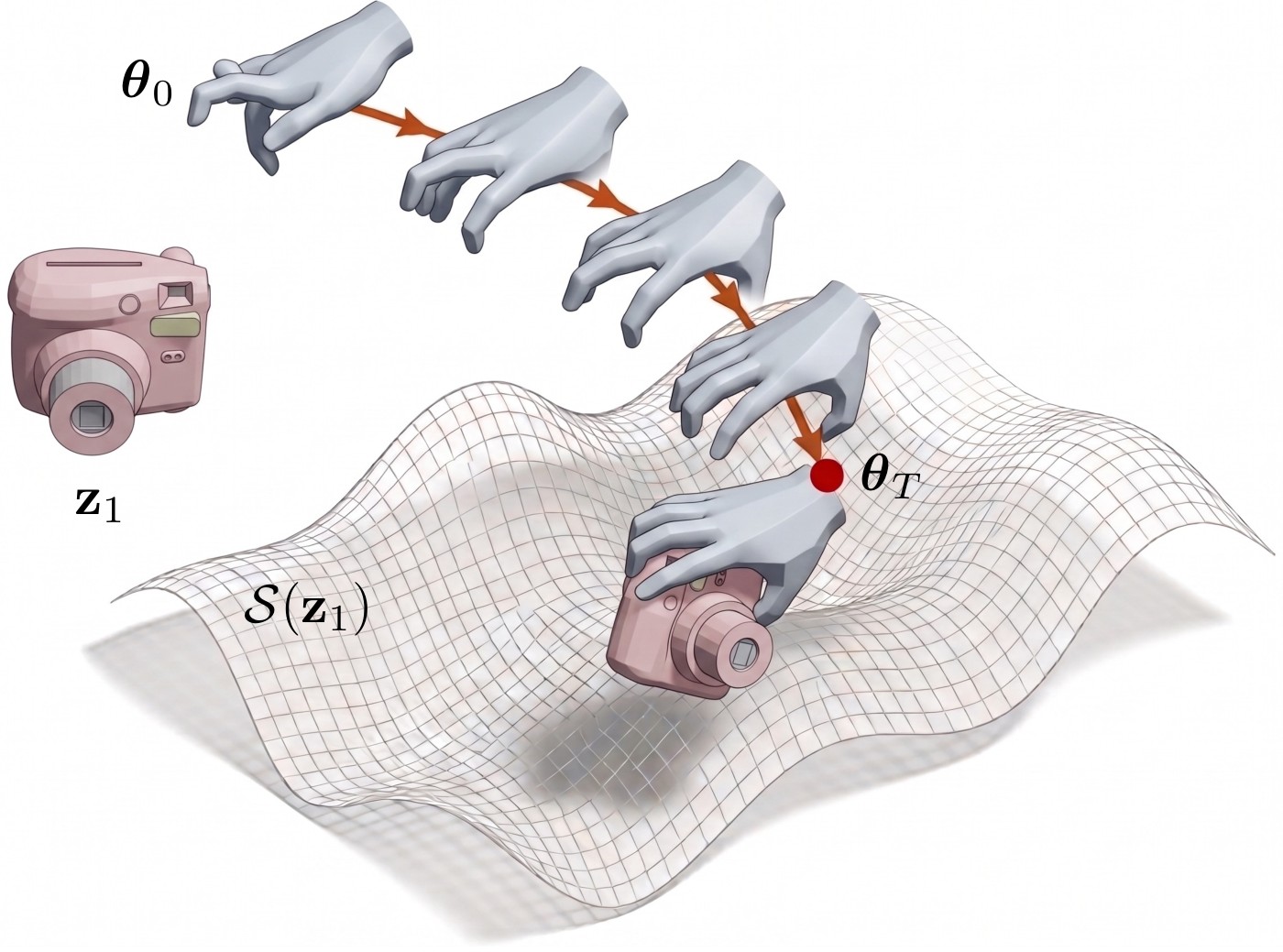
Denoising, completion, generation and image-based recovery share the objective below: a task-specific data term plus the squared field value as a prior, minimized over the hand pose.

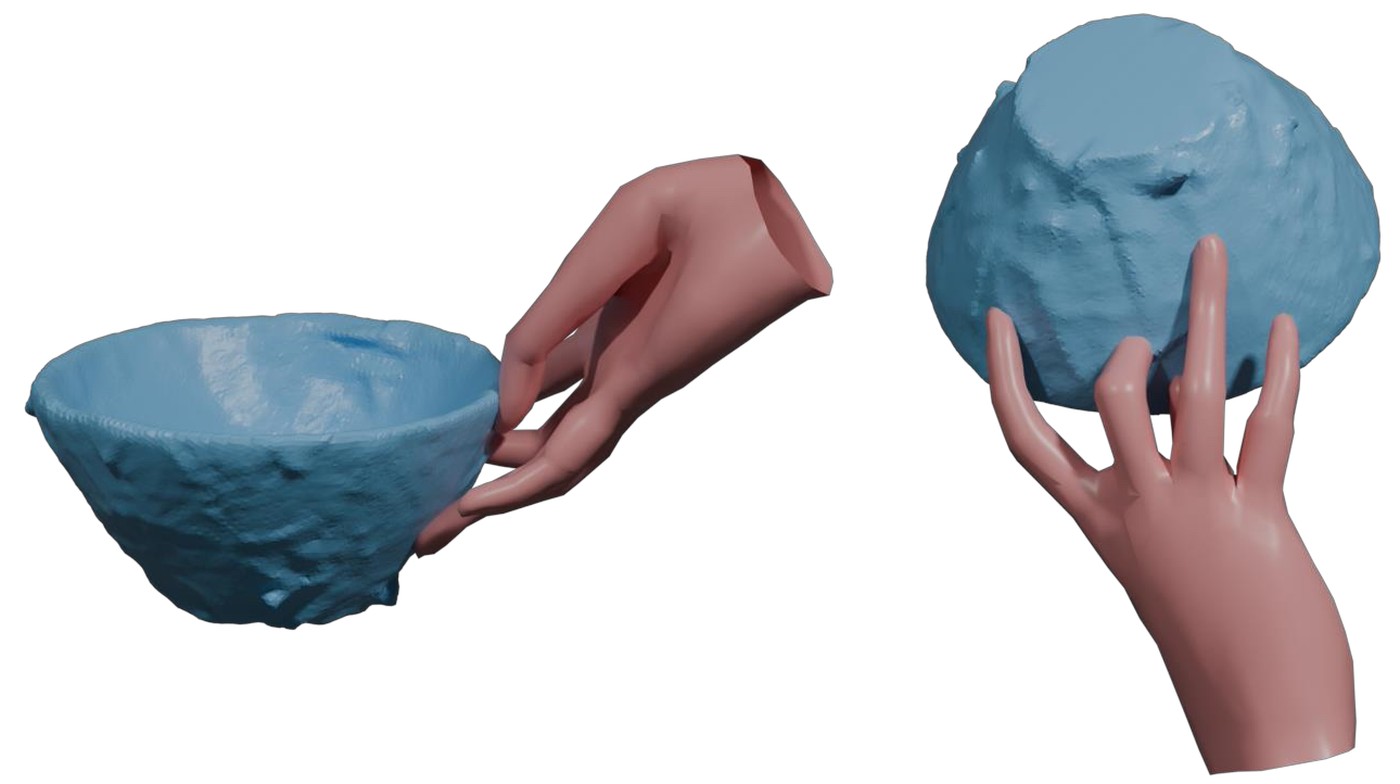
The slider shows the pose at t = 0, 100, 300, and 1000 projection steps, with the ground-truth pose on the right.
Noisy pose
Ground truth
Noisy pose
Ground truth
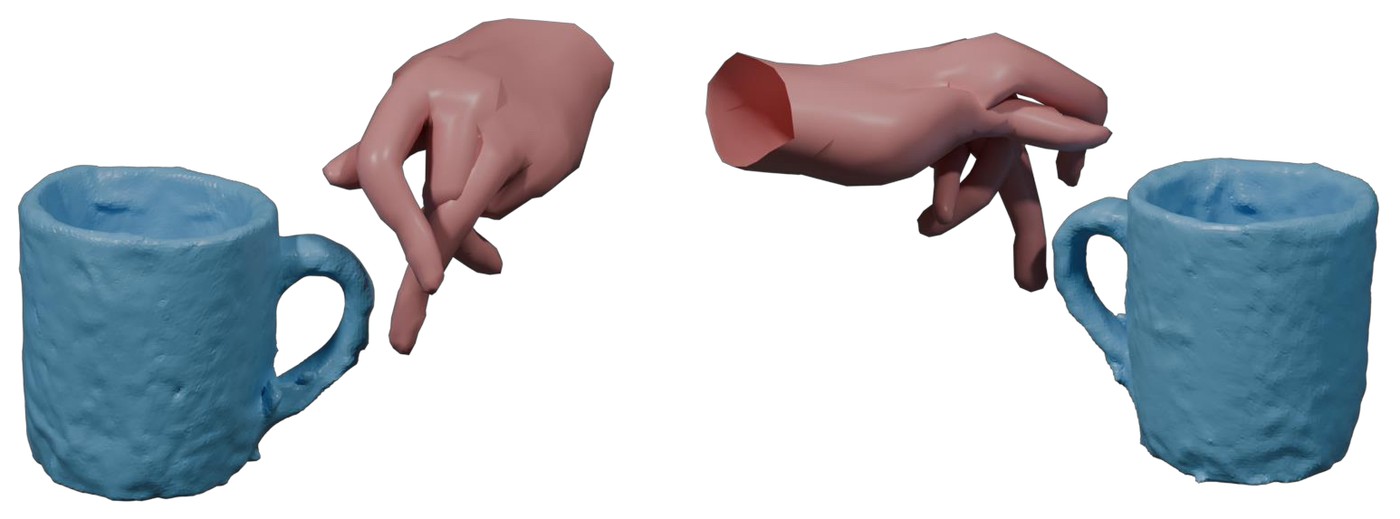
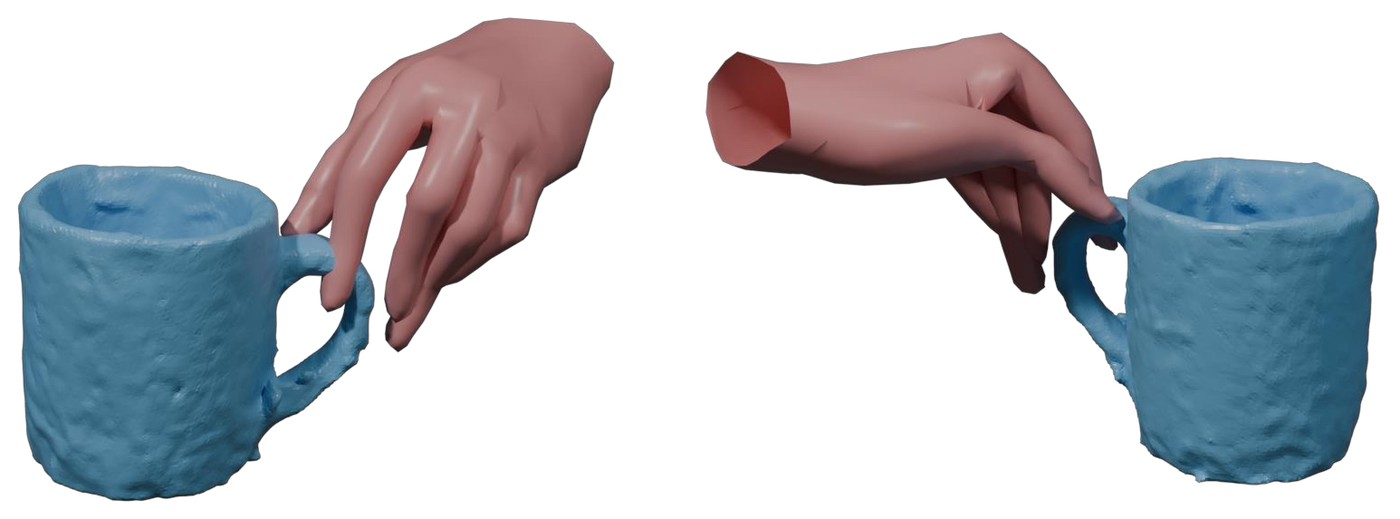
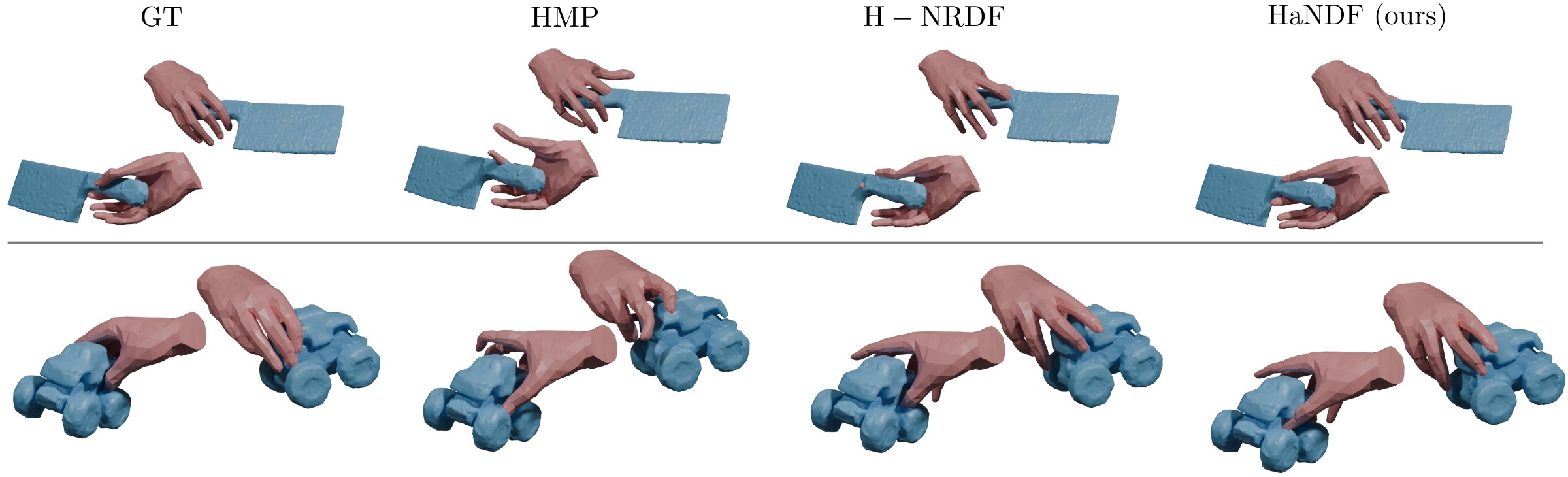
Denoising with different priors. Columns: ground truth, HMP, H-NRDF (NRDF trained on hand poses), HaNDF.
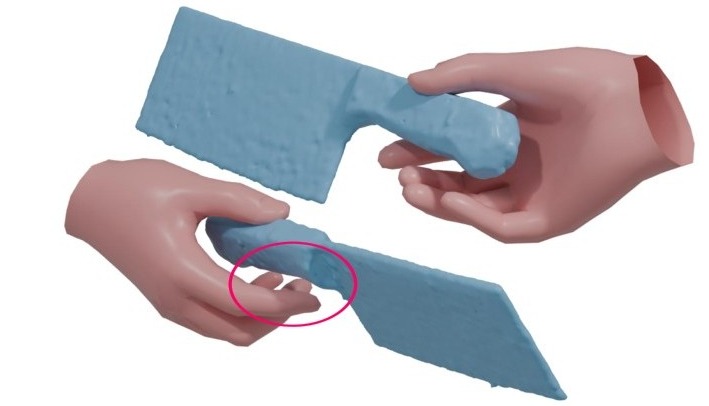
HaNDF is added as the hand prior to EasyHOI and AlignSDF; evaluation on HOI4D, OakInk and DexYCB. For hand-focused comparison, the object ground truth is provided during inference. MPVPE and MPJPE: mean per-vertex and per-joint position error of the hand. I.V.: hand–object intersection volume. Lower is better.
| HOI4D | OakInk | DexYCB | |||||||
|---|---|---|---|---|---|---|---|---|---|
| Method | MPVPE ↓ | MPJPE ↓ | I.V. ↓ | MPVPE ↓ | MPJPE ↓ | I.V. ↓ | MPVPE ↓ | MPJPE ↓ | I.V. ↓ |
| iHOI | 19.42 | 20.12 | 41.44 | 14.75 | 15.17 | 1.66 | 29.85 | 30.73 | 1.26 |
| EasyHOI | 16.64 | 17.06 | 13.28 | 13.17 | 13.48 | 0.93 | 29.64 | 30.08 | 2.61 |
| EasyHOI + HaNDF | 13.98 | 14.33 | 11.40 | 12.85 | 13.12 | 0.89 | 28.31 | 28.78 | 2.43 |
| AlignSDF | 10.40 | 10.60 | 5.39 | 10.34 | 10.50 | 0.82 | 16.82 | 17.19 | 0.99 |
| AlignSDF + HaNDF | 10.22 | 10.43 | 4.39 | 9.98 | 10.17 | 0.87 | 16.59 | 16.97 | 0.98 |
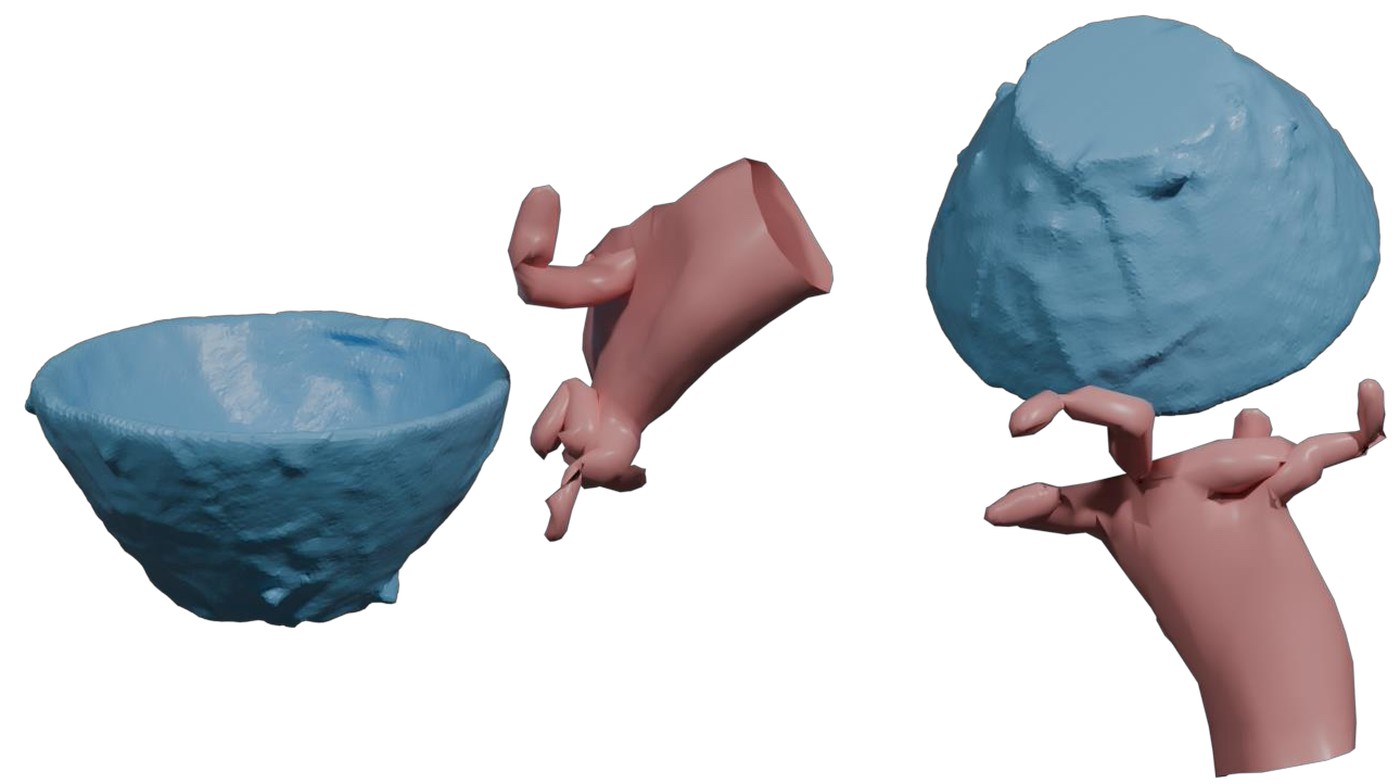
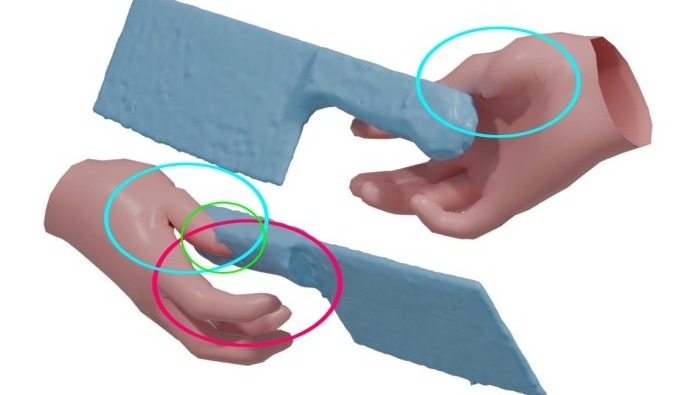
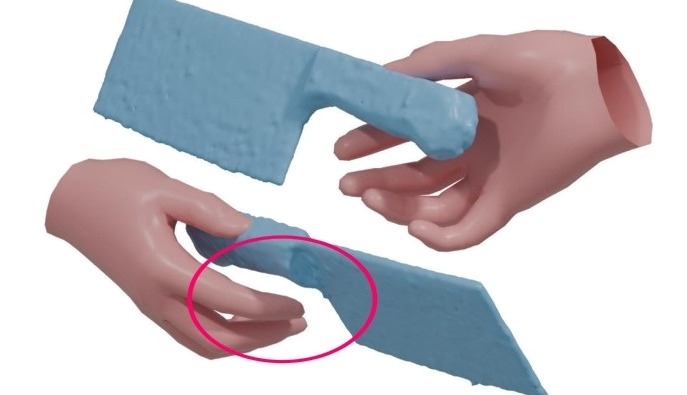
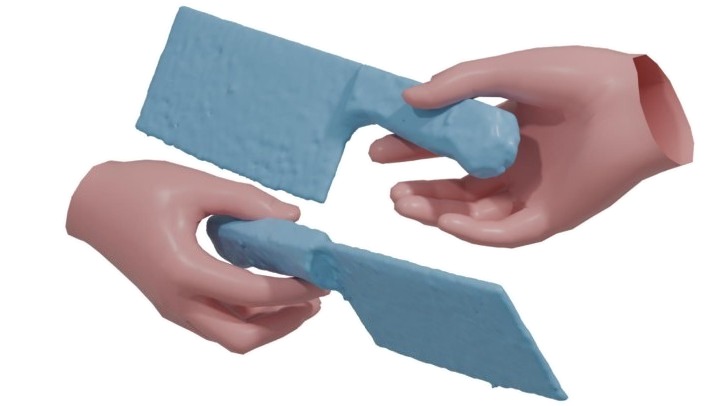
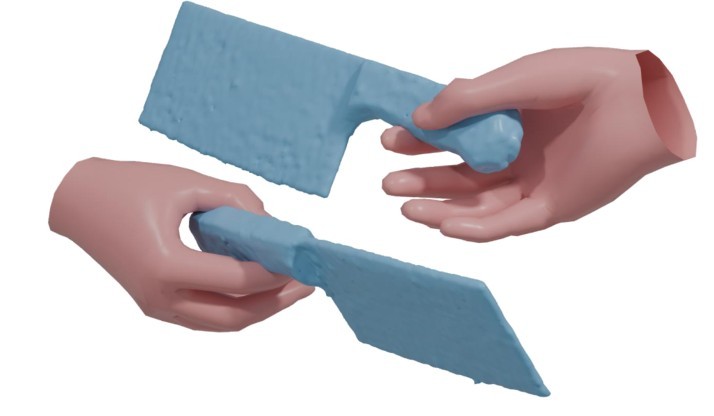
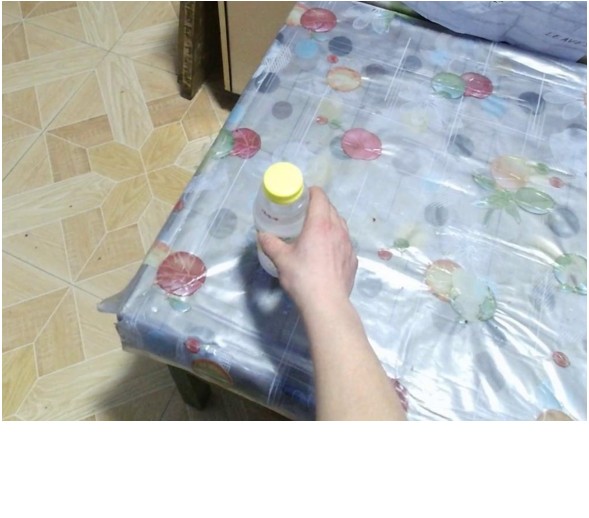
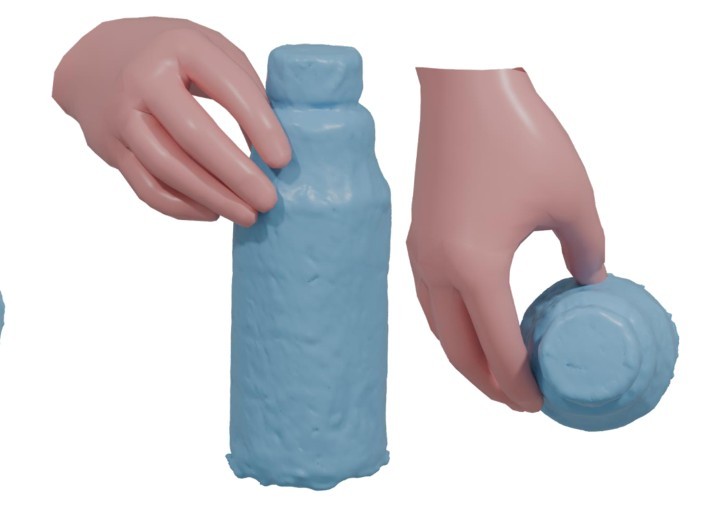
Left: baseline reconstruction. Right: reconstruction with HaNDF. Circles mark missing hand–object contact, object penetration, and implausible hand rotation.
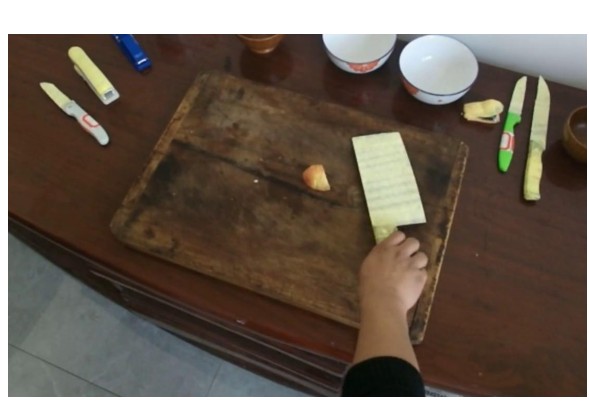
Input
 EasyHOI
+ HaNDF
EasyHOI
+ HaNDF
 AlignSDF
+ HaNDF
AlignSDF
+ HaNDF
Ground truth
Input
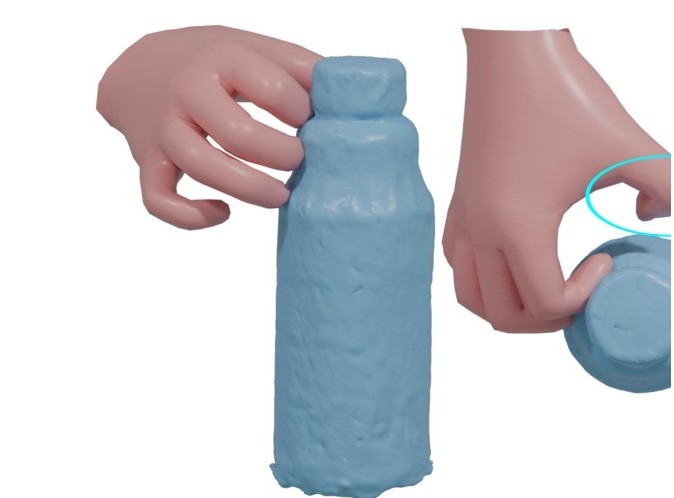
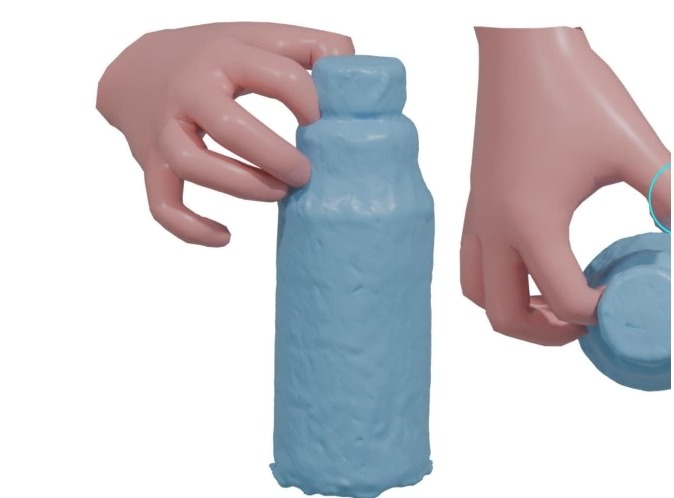 EasyHOI
+ HaNDF
EasyHOI
+ HaNDF
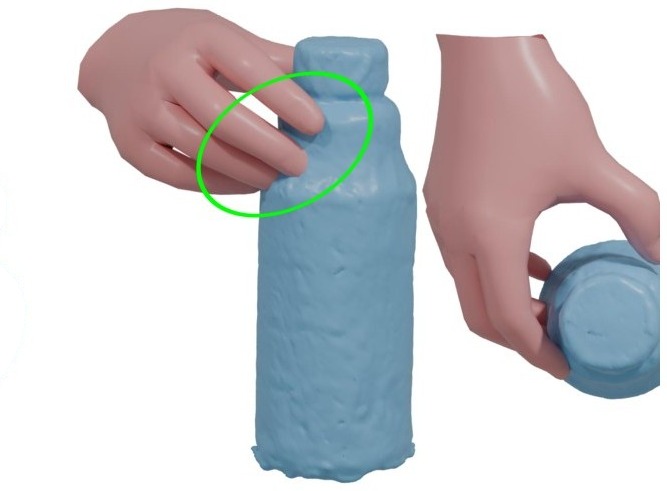
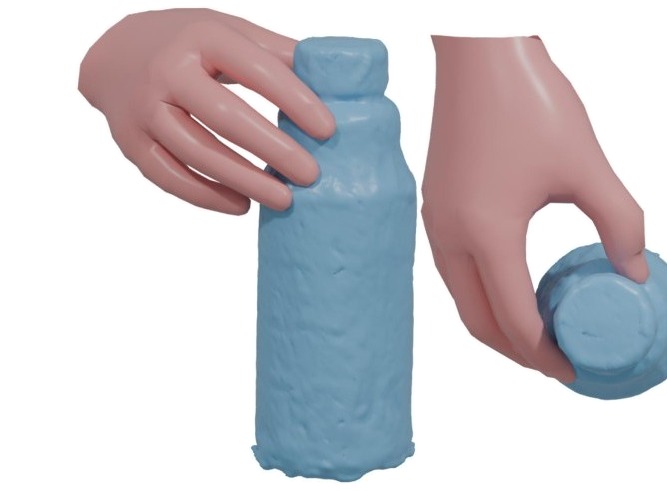 AlignSDF
+ HaNDF
AlignSDF
+ HaNDF
Ground truth
We thank the authors of the following works for providing their valuable code and data:
NRDF: Neural Riemannian Distance Fields for Learning Articulated Pose Priors
PoseNDF: Modeling Human Pose Manifolds with Neural Distance Fields
EasyHOI: Unleashing the Power of Large Models for Reconstructing Hand-Object Interactions in the Wild
AlignSDF: Pose-Aligned Signed Distance Fields for Hand-Object Reconstruction
HMP: Hand Motion Priors for Pose and Shape Estimation from Video
iHOI: What's in your hands? 3D Reconstruction of Generic Objects in Hands
HOI4D: A 4D Egocentric Dataset for Category-Level Human-Object Interaction
DexYCB: A Benchmark for Capturing Hand Grasping of Objects
OakInk: A Large-scale Knowledge Repository for Understanding Hand-Object Interaction
T. Birdal was supported by a UKRI Future Leaders Fellowship [grant number MR/Y018818/1]. The authors acknowledge support from the UK AI Research Resource (AIRR Isambard AI) through grant 0251-4584-0945-1 - TopoFound.
@inproceedings{liu2026handf,
  title     = {{HaNDF}: Object-Conditioned Geometric Neural Hand Distance Fields},
  author    = {Liu, Zuhao and Darcan, Melih and Yu, Zhengdi and Guler, Riza Alp and Birdal, Tolga},
  booktitle = {Advances in Neural Information Processing Systems (NeurIPS)},
  year      = {2026}
}