RNADyn: A Benchmark for Generating
and Understanding RNA Dynamics

Overview
RNADyn brings together standardized all-atom RNA trajectories and a unified model for generating and understanding RNA dynamics. RNADynBench provides the data foundation; RNADynNet learns to generate trajectories and extract dynamics fingerprints from a single conformer.
Key Contributions
- RNADynBench — A standardized data foundation. 2,585 quality-controlled, 100-ns all-atom RNA trajectories, with leakage-controlled splits and evaluation protocols for trajectory generation and dynamics prediction.
- RNADynNet — A unified dynamics model. A shared backbone connects RNA trajectory generation and single-conformer dynamics representation learning through trajectory-informed alignment and physical grounding.
- All-atom RNA trajectory generation. A benchmark evaluating molecular geometry, fluctuations, and conformational distributions across structural-generalization and high-flexibility test sets.
- Transferable dynamics representations. Single-conformer fingerprints encode information about MD-derived fluctuations and motion coupling and support transfer to RNA–ligand binding prediction.
RNADynBench
Experimental structures, standardized simulations, and shared evaluation protocols.
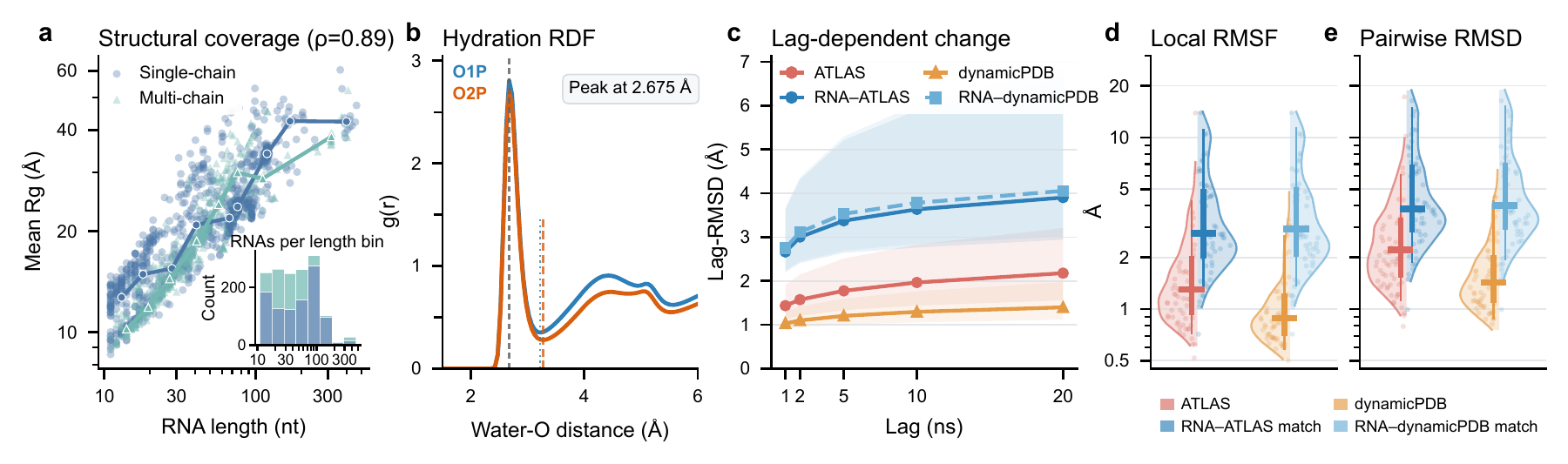
Structural coverage and physically plausible hydration.
Panel (a) summarizes RNA length and size coverage, showing increasing mean radius of gyration with sequence length. Panel (b) shows phosphate hydration profiles with a first-shell peak near 2.7 Å, consistent with prior nucleic-acid simulations and supporting the physical plausibility of the local solvent environment.
RNA exhibits greater conformational motion than size-matched proteins.
Compared with ATLAS and dynamicPDB, RNADynBench shows higher lag-RMSD (c), local RMSF (d) and pairwise RMSD (e) within the sampled simulation window.
RNADynNet
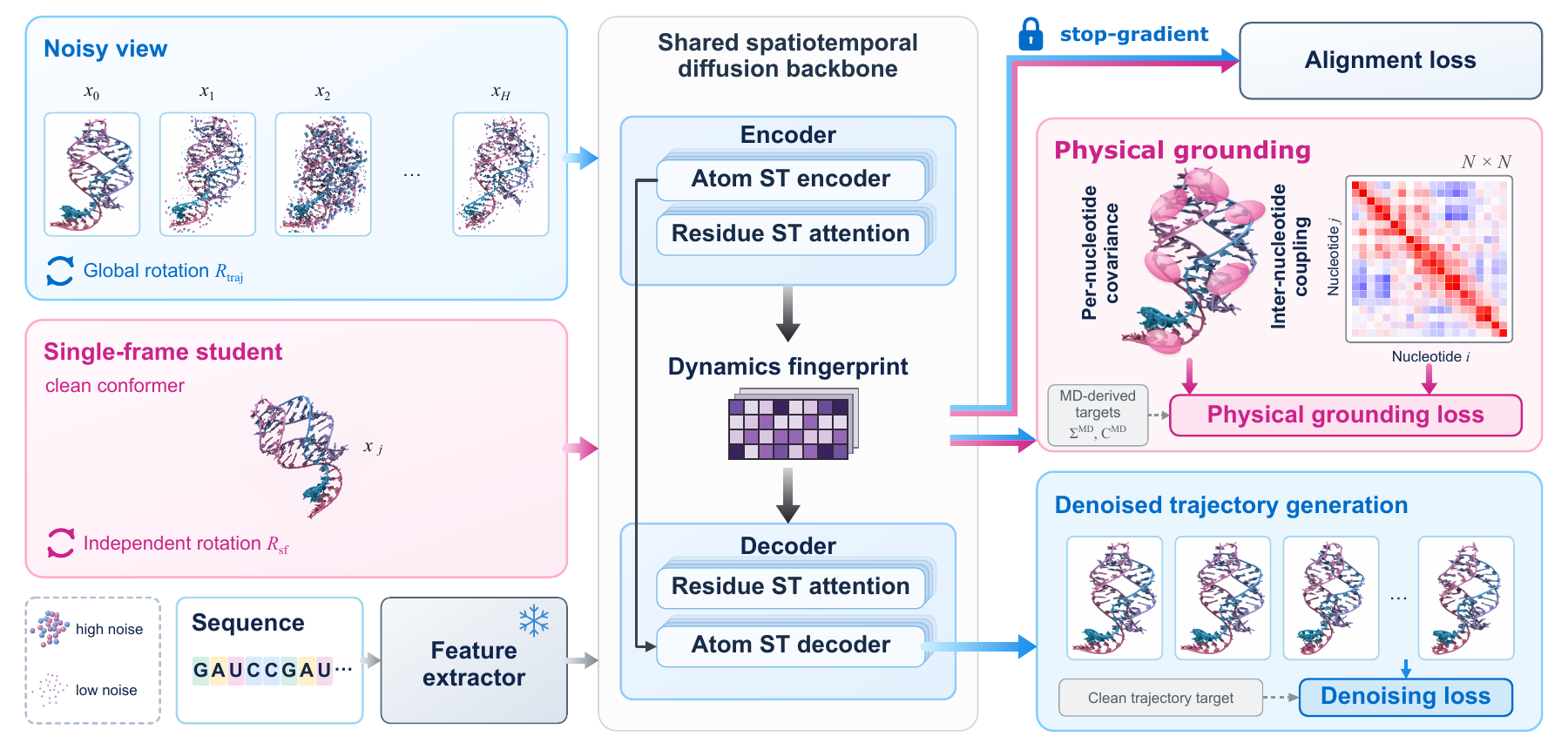
RNADynNet unifies RNA trajectory generation and single-conformer dynamics representation learning within a shared spatiotemporal diffusion backbone. Trajectory-informed alignment and physical grounding connect the two capabilities during training.
Trajectory generation
Generate RNA conformational trajectories from an initial conformer, conditioned on a temporal horizon and sampling interval. A hierarchical forecasting-and-interpolation sampler produces the trajectory.
Dynamics fingerprints
Extract a dynamics-aware representation for each residue directly from a single conformer, without sampling a trajectory. Physical prediction heads further estimate residue covariance and normalized motion coupling (NMC), with RMSF derived from the predicted covariance.
Trajectory denoising
Reconstruct RNA trajectories under heterogeneous coordinate noise, learning from spatial relationships between residues and temporal context across frames.
Single-frame-to-trajectory alignment
Train single-conformer representations to match trajectory-contextualized residue features, transferring information about motion into the single-frame encoder.
Physical grounding
Supervise both trajectory and single-conformer representations with MD-derived residue covariance and inter-residue motion coupling, tying learned features to measurable dynamics.
Results & Examples
Trajectory generation
Reference MD and RNADynNet side by side: 101 saved frames over 0–100 ns. Each pair shares a fixed view and scale, after C1′ alignment to the initial MD structure.
View denoising snapshots
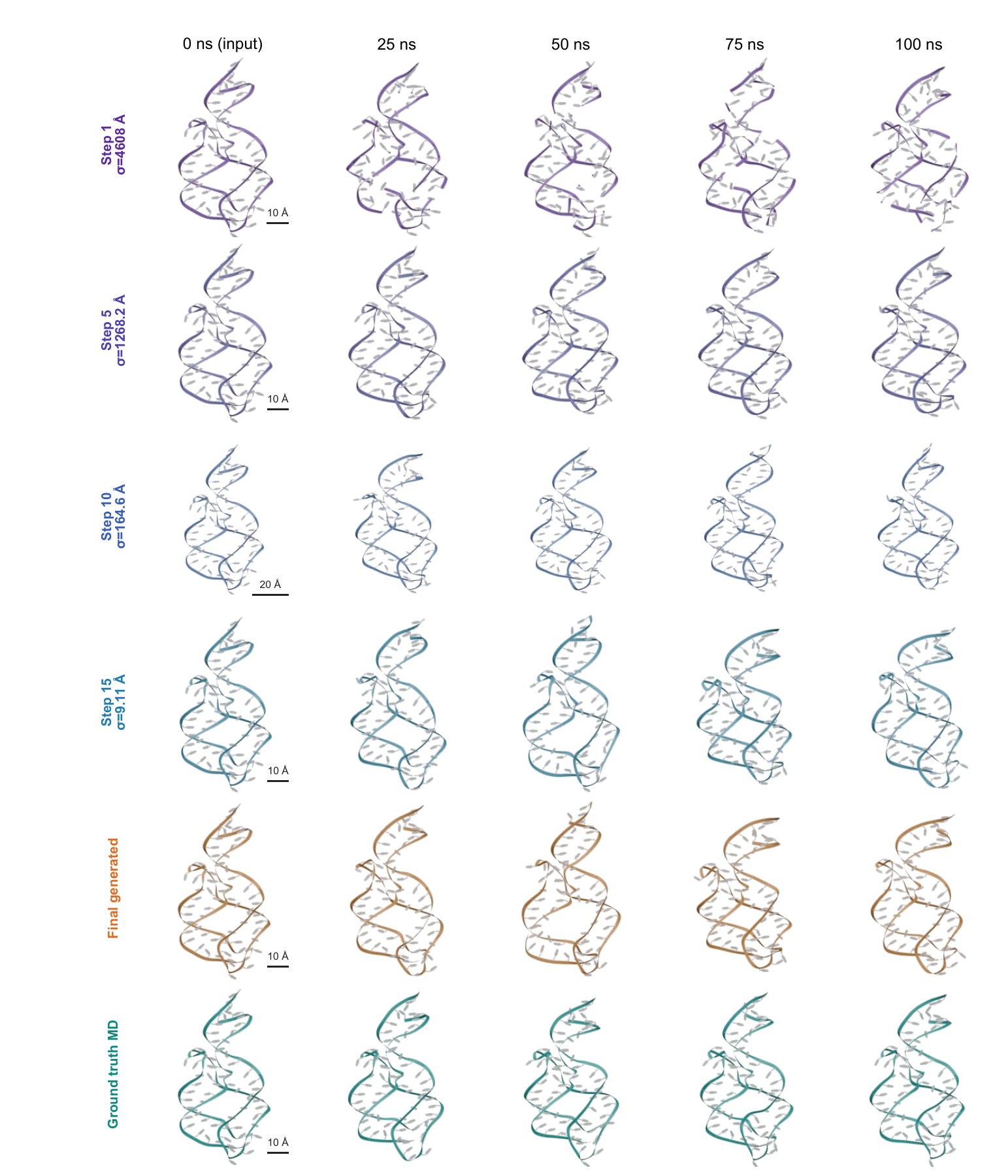
View denoising snapshots
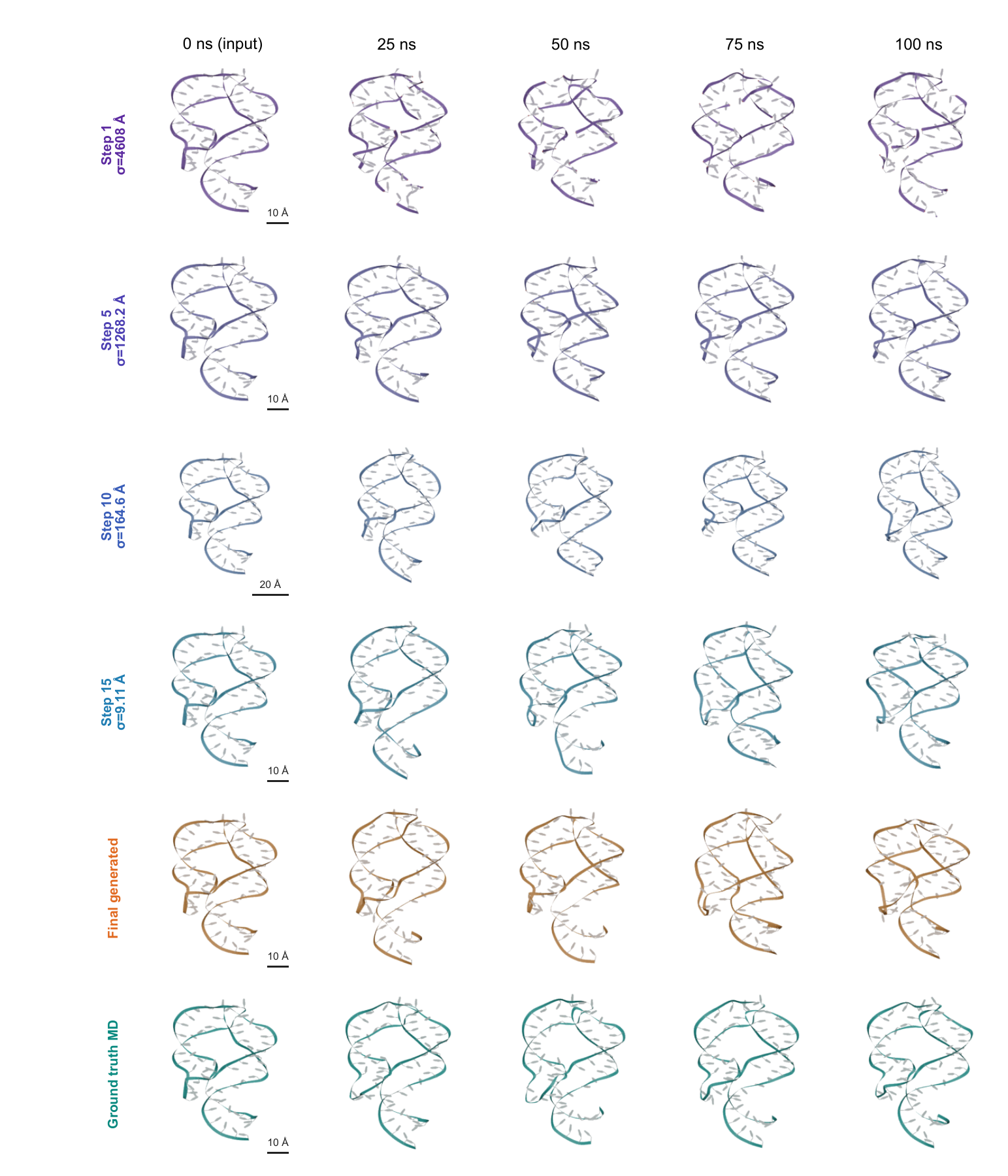
View denoising snapshots
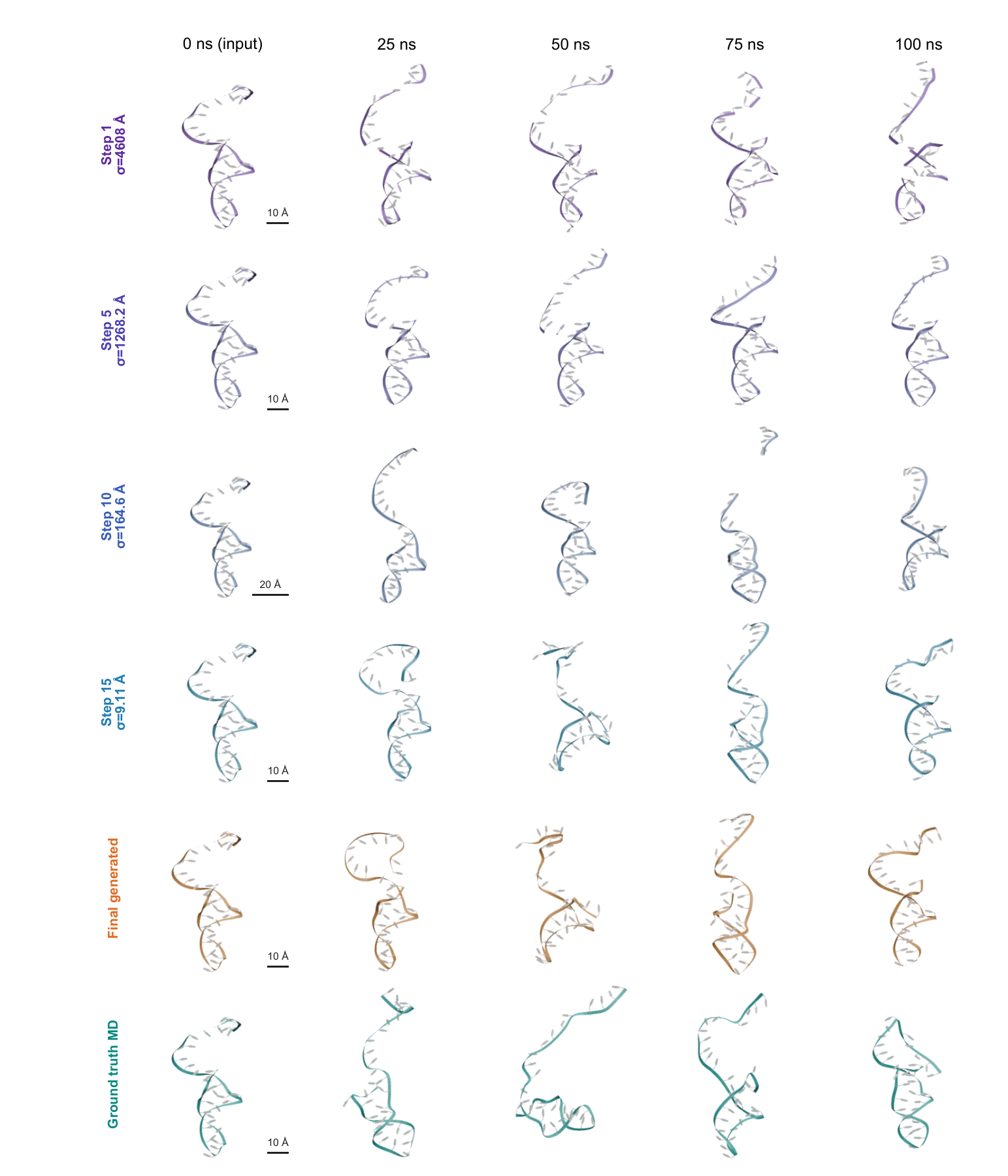
Qualitative examples use the manuscript-selected sample 0 from four generated trajectories per case. Generated paths are not frame-by-frame reconstructions of MD. No coordinate interpolation is applied; the loop restarts at 0 ns. Backbone gaps mark O3′–P distances ≥ 2.6 Å. View scales may differ between cases.
Dynamics from a single conformer
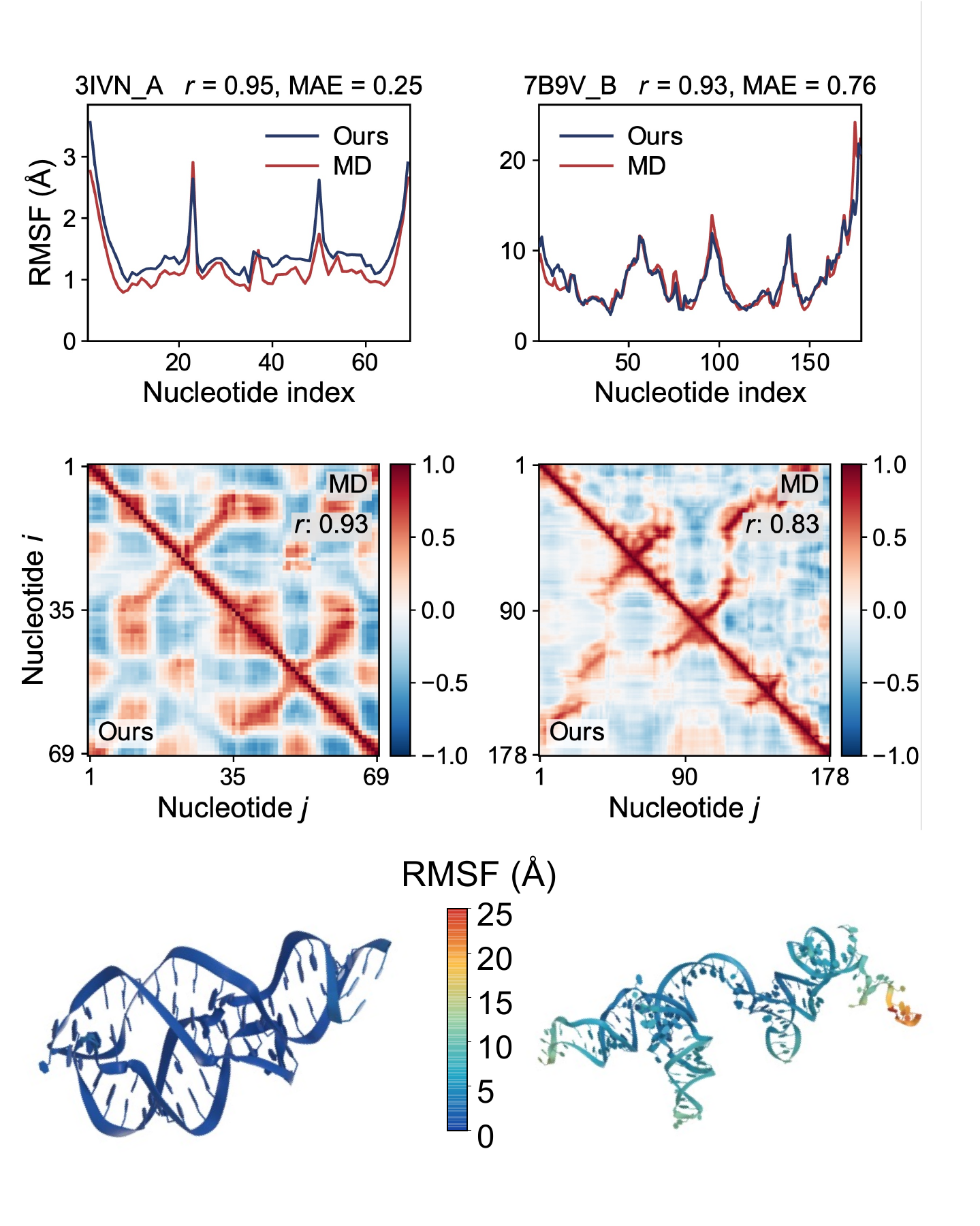
RMSF-colored structures, fluctuation profiles and normalized motion coupling matrices from manuscript Figure 3.
NMC matrices show RNADynNet below the diagonal and MD above. All outputs are precomputed.
Benchmark results
Separate tasks, separate test splits. RNA-group macro averages.
| RNADynNet metric | test_struct | test_flex |
|---|---|---|
| Generated trajectory · RMSF r | 0.8746 | 0.7658 |
| Native prediction head · RMSF r | 0.8665 | 0.7827 |
| Native prediction head · NMC r | 0.8115 | 0.7614 |
Manuscript results; reproducibility resources pending release.
View full benchmark →Paper
Citation